
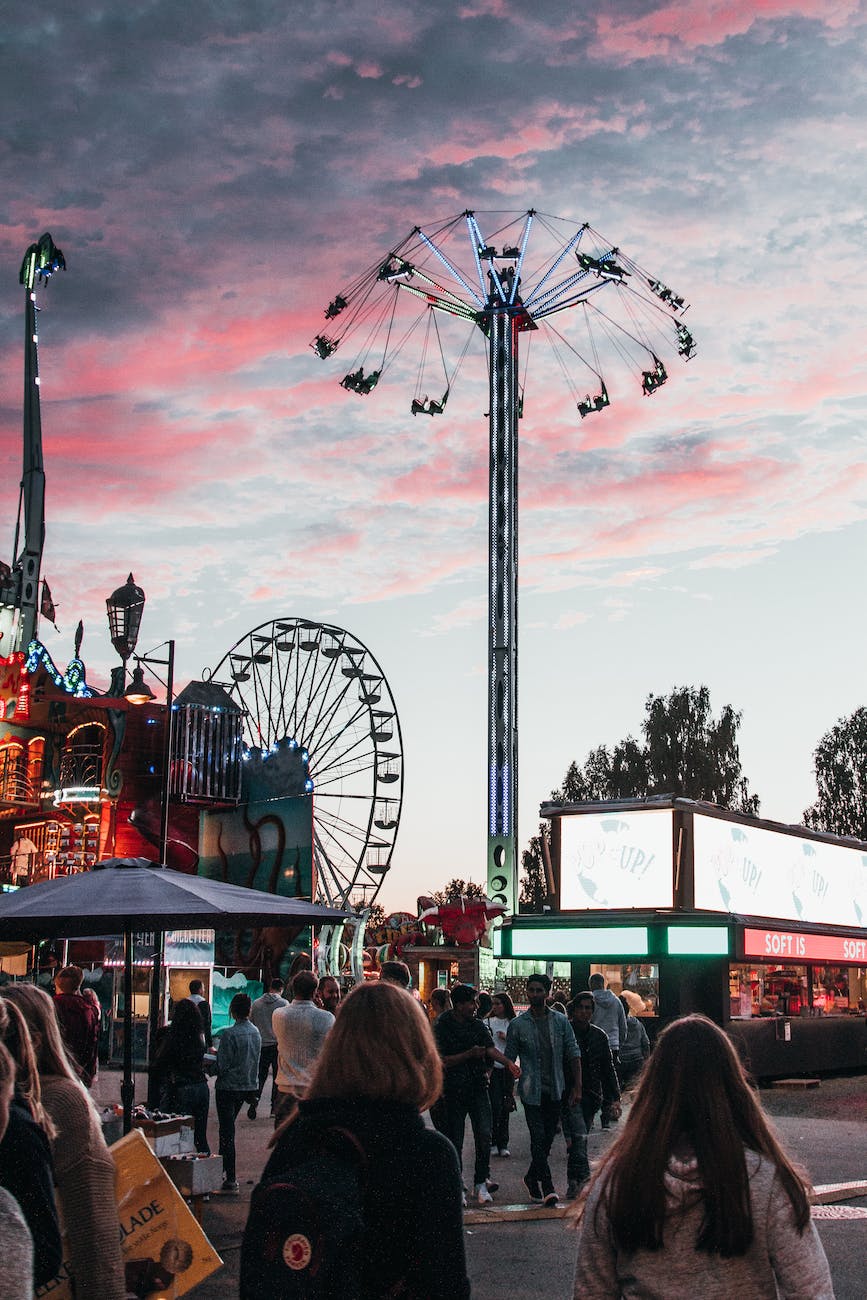
He was a man of the Carnival, a carnie at heart, though sometimes he dabbled in real-world customs—mostly because he’d never really been a part of them. But the longer he stayed away from the Carnival, the clearer it became: the carnie life was forever his.
Everything was simpler there. Born into it, Dusty couldn’t imagine life any other way. His childhood memories were etched with the creaky melody of the Ferris wheel—clang-clang-clang-click-clang-click—each cart swaying with the weight of kids’ laughter, reverberating through the metal bars wrapped with lights, posters of popcorn and cotton candy, arcade games. The sound mingled with the music drifting from all over the grounds, a constant soundtrack to his life.
As a boy, he’d been embarrassed by it all—ashamed of his mother, the fortune teller, and his father, considered a freak. He sometimes had nightmares about his father. But now, he looked back and saw the man differently.
His father was enormous, six foot eleven, his misshapen head giving him a monstrous height. As a child, Dusty thought of him as a creature, a monster. But beneath that unusual frame—arms long enough to reach his knees, legs scrawny and twisted, a spine hunching forward with a cruel curve—lived warmth, humor, and a fierce determination to provide for his family. He had survived ridicule, built a life, and held his head high. Dusty, for all his understanding later, had once feared him, and the memory of that fear still lingered.
He learned from both parents, in different ways. His father showed him that evil doesn’t always wear a monstrous face, and that goodness doesn’t require perfection. His mother… less so.
After his father died when Dusty was twenty-one, he and his mother struggled to survive, living in a tent as the Carnival traveled north to colder cities near the Lake. Food was scarce, warmth rarer still. Over time, Dusty watched his mother change. She grew erratic, delusional—accusing the carnival barkers of stealing her tarot cards, climbing atop platforms to shout about devils and serpents, falling silent for hours while scratching herself raw.
Dusty worried for her, tried remedies that failed. Finally, at twenty-five, he admitted her to a mental health facility, and he hasn’t seen her since. He let her live her life, he lived his. He kept the simple life he knew, one grounded in routines he could control.
Unlike his parents, Dusty was normal—except for his height, six-seven—but that sufficed. He ran a hot-dog and fry stand, saved diligently in a metal tin, and by twenty-eight, he opened it to find twelve thousand dollars. Enough for a down payment on a house. He’d learned that from Thomas, the carnival barker who’d taken him under his wing. He thought about leaving the Carnival for the “real world,” but the world outside hit him like a ton of bricks. People were selfish, arrogant, disrespectful. Cruelty hid behind polite smiles.
Humans dehumanize each other, he realized, to justify treating others horribly. Greed, vanity, blind consumption—everyone chasing the next trend or product, believing it could make them whole. Dusty tried the small niceties he knew from the Carnival: a smile, a greeting. He was met with indifference, suspicion, avoidance. He saw a woman drop her folder, papers scattering. Passersby ignored her. Dusty helped, but his hope dwindled.
Loneliness pressed in. Even nights out seemed staged: laughter on cue, conversations robotic, everyone waiting to peel off their masks when they returned home. The real world felt hollow. There was no joy in pretending to be someone you’re not. At the Carnival, he was loved for who he was. That feeling was priceless.
Months later, after renting a dingy bachelor apartment, Dusty finally admitted it: he couldn’t live this way. He packed his belongings and returned to the Carnival. Home, he realized, was where the heart was. For him, that heart beat among the tents, rides, and familiar clang of metal. The simple life he once took for granted—the routines, the camaraderie, the laughter—was his truth. The world beyond had illusions, but the Carnival was real.
Dusty never looked back.
If you are interested in reading about a variety of different subjects such as mental health, inside the minds of disturbed artists, the importance of being an introvert, importance of body language and non-verbal communication, the importance of mental rehearsal and imagery, the power of our minds, mindfulness, metaphysics and the cosmic world and how all the great genius’ of the past have tapped into this power to achieve seeming miracles, addiction, abuse, the effects loneliness and so much more, please check out some of my other posts:

One thought on “The Illusion of Elsewhere”
Comments are closed.